Showing posts with label Non-fiction. Show all posts

Monday, 20 June 2011

Cheap : the high cost of discount culture / by Ellen Ruppel Shell

0 comments so far. What do you think?


If you enjoy the warm afterglow of bagging a bargain at your local big box store, then Cheap is the cold shower that might give you pause for thought. Many things are certainly a lot cheaper than they have ever been. From 1971 to 2003, as incomes rose, Americans spent 32% less on clothes, 52% less on appliances, and 18% less on food. However, over the same period mortgage payments increased 76%, health insurance 74%.
So things are not cheap where it counts, and those things that are cheap are not sustainable, for they are cheap at the expense of skills, wages, the environment, human rights & culture. You would need half a dozen books or more to do this subject justice. Thankfully, Ellen Ruppel Shell provides extensive references for those wanting to explore, say, the insights gained from the studies of consumer behaviour in the chapter "Winner Take Nothing”.
Purveyors of cheap have turned traditional retailing on its head -
"Discounters shroud their offerings, selling virtually identical products as different brands, and B-grade versions of national brands. Or, like IKEA, they hide shoddy construction - and questionable practices - with clever image making and design. The cheaper the goods, it seems, the harder retailers work to keep us from knowing about them, and the more narrowly we focus on price, the easier we are to fool."
Product knowledge thus seems impossible in a world of commerce where it is difficult to know where a product came from or the conditions under which it was manufactured. And if consumers cannot buy based on knowledge of product, then price alone becomes the determinate. This triumph of cheap was abetted by television advertising which, the author argues, “was particularly vital for the low service discount chains that, with no experienced salesforce to push product, relied on the customer to come to their stores pre-loaded with wants."
Is there a solution? How to arrest price's race to the bottom, dragging living wages and the environment with it? Even with laws in place, there is still human nature to contend with. By way of a remedy of sorts, Shell takes her cue from Adam Smith's ideal of "enlightened self interest”, and gives us the closest to a working example in Wegmans Food Market. The key to company profits seems to be investment in well remunerated and looked after staff, which in turn attracts and keeps customers, qualities beyond mere price that support wages and profits.
An excellent book, even if the ideal marketplace of Adam Smith seems unattainable. Perhaps the user generated revolution of Web 2.0 will assist in greater product awareness amongst consumers. Or does the promise of instant gratification via online bargains just compound the problem?


Share/Save/Bookmark

Saturday, 11 June 2011

Clutter busting : letting go of what's holding you back / by Brooks Palmer

0 comments so far. What do you think?
What the author lacks in modesty he at least makes up for with some practical tips on how to tackle those piles of papers and other stuff that prevent one from feeling fully at home in one's home.
Some of his comments are just silly (such as the cat peeing on its owner's sofa because that sofa belonged to an ex-partner and thus had to be "clutter-busted"), while others reveal the kind of Oprah-style narcissism that American pop psychologists are so good at (under the heading "The Importance of Compassion" he means compassion for oneself!). And, like Oprah, he even clutter-busts the homes of famous celebrities (though becomes coy, all of a sudden, about dropping names).
Yet, beyond the hokum, there are some good strategies for dealing with too much stuff. He makes a good point that too often people hang onto things because they represent a false ideal of what they wish they were, or had failed to become. And it was heartening to read that he has a go at the advertising industry that sucks people into thinking they need to buy and acquire stuff to feel good about themselves A useful book, but I suspect there are better tomes like it on the market.


Share/Save/Bookmark

Wednesday, 18 May 2011

Born to Run: the hidden tribe, the ultra-runners and the greatest race the world has never seen / Christopher McDougall

0 comments so far. What do you think?
Very rarely can you say that a book actually changed your life, but I can say with complete conviction that Born to Run did. I first heard about it in the blog post Top Reads for 2010 in which my work colleague, Danny named this one (thanks Danny). I was fascinated from the first page and over the three weeks that I read it, I ran my first half marathon, started running long distances with a weird looking smile on my face and made the decision to train and run competitively. Yep - it was an inspirational book.

It follows Men's Health writer Christopher McDougall as he goes in search of the answer to his question: why does my foot hurt?

This leads him on a long journey of discovery, investigating the human body, why we run, how we run and whether we were born to run. The bulk of this journey revolves around a tribe of Mexican Indians, the Tarahumara. The Tarahumara are largely unknown, yet they are the greatest long distance runners in the world. At the few internationally aclaimed races they have attended, they have beaten world class athletes while wearing hand-made sandals.

In his quest to find out more about this mysterious people, McDougall meets Caballo Blanco, a man who has lived amongst the tribe, adopting some of their running and lifestyle practices. Together, Blanco and McDougall organise the ultimate running challenge: the Tarahumara take on some of the best ultramarathoners worldwide in a 50 mile race through the Copper Canyons of Mexico.

The book is beautifully written and keeps the reader hooked the whole way through. McDougall does more than merely describe events, he examines characters and gets beneath the surface of running. One common denominator between all the runners mentioned in this book, is their love of the sport. It's more than a race for them, it's about enjoyment and happiness. From a personal perspective I felt this happiness rubbed off on me and now when I run, I don't feel like I'm struggling -  I just feel relaxed (hence the weird smile).

It also looks at issues of injuries, barefoot running and competitive running. Is it our shoes that are in fact giving us injuries? Are our bodies built for running? What is it that the Tarahumara do that no one else does?

I'd highly recommend this book especially for anyone who loves to run.


Share/Save/Bookmark

Saturday, 12 February 2011

A Fortunate Life by A. B. Facey

1 comments so far. What do you think?
This book has been on my "must read" list for a long time, if only for the fact that everyone around me has read it, never mind its canonical status in Australian literature.
A Fortunate Life is an epic yarn of one man's life, simply told, from the horrors of his mistreatment as a child farm worker to the even greater horrors of his experiences at Gallipoli in World War One. Yet the horrors are leavened with stories of humour and great achievement in farming the unforgiving country of rural Western Australia, raising a big family during the Depression and teaching himself to read and write.
A standout section for me was the author's recollection of his six months on a cattle drive through central Western Australia in 1909 when he was not yet 15 years old. This included a harrowing week lost and alone in the bush, surviving on grass and scavenged kangaroo meat, culminating in an encounter with Aboriginal Australians that not only saved his life but altered his perceptions.
Facey genuinely feels "thrilled" looking back on his life, despite the terrible hardships endured, because he relished a challenge and never faltered in his belief at "having a go at something", always "ready to take a risk and try something new. If it worked out, well good, if not I would just try something else." And he had a go at plenty of things: farming, fencing, dam building, boxing, soldiering, droving, house building, tram and truck driving, union delegate ...
A few chapters into this book and I was shaking my head, asking myself "How much more can this bloke stand?" He meets some wonderfully supportive people along the way, yet is also quite up front with the reader regarding those who mistreated or took advantage of him, including his mother who pretty much abandoned him when he was eight years old. I was amazed at his resilience, not just in surviving but in creating such a full and fulfilling life, a life that encompassed some of the iconic periods of modern Australia.
Highly recommended. A must read, that's if you haven't read it already.


Share/Save/Bookmark

Thursday, 10 February 2011

The Country Show Cookbook : award winning recipes from country shows

0 comments so far. What do you think?
One of my favourite pastimes, which I find very relaxing, is baking.This cookbook is full of old fashioned tried and true traditional recipes which have been handed down through the generations. The Show winners commence with scones, progress through cakes, puddings, pies, slices and tarts to the finale....pickles and jams.
As well as pictures of the goodies, there are old fashioned Show pictures e.g. a beautiful kelpie, a wood chopper.
I have tried, tested and tasted many of the recipes in this book, with my favourite being on page 44, moist and easy chocolate cake, a winner at the Morisset/Lake Macquarie Show when entered by Barbara Potter.
Over Easter, why not not treat the family to a good old fashioned afternoon tea?

Wendy...Sylvania


Share/Save/Bookmark

Thursday, 3 February 2011

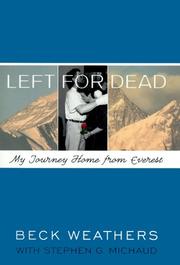
Left for Dead : My Journey Home from Everest - Beck Weathers witb Stephen G. Michaud

0 comments so far. What do you think?
This is yet another book related to Mount Everest (I've gone on some kind of Everest reading rampage since coming back from Nepal in November). Left for Dead follows the story of Beck Weathers, a survivor of the 1996 Everest tragedy, as he rebuilds his life - or at least that's how the book is promoted. In realtiy it is more about the breakdown and rebuilding of a marriage centred around mountain climbing.

For those that don't know, Beck Weathers was trapped on Mount Everest near the Summit in 1996 when the infamous storm hit. He was close to death when the rescue party made the decision to leave him. Miraculously, he woke the next day and made the journey back to high camp on his own - all while badly frostbitten and almost blind. He was later rescued from the mountain in a daring helicopter evacuation. Weathers ultimately lost his nose and both hands from frostbite.

This story is essentially not about his struggle to deal with the mental and physical scars of what happened on the mountain, but about his struggle to save his marriage. Weathers, a sufferer of depression, took up mountain climbing as a way of escape. Unfortunately, it also meant neglecting his family and marriage. By the time he went to Everest in 1996 his wife, Peach, was ready to leave him.

The book is written from the perspective of Weathers as well as his close friends and family, including Peach. This gives us a first hand account of the mental scars the family suffered. The children were badly hurt by their father's neglect while Peach is filled with such bitterness that I wondered if the marriage was still intact today. It is a unique read - the first account I've seen of the effect mountain climbing can have on the families of those that pursue the sport.

Overall, I think this is essential reading for any mountain climber. It just shouldn't be marketed as a story about Everest. 


Share/Save/Bookmark

Wednesday, 12 January 2011

The Longest Climb - Dominic Faulkner

1 comments so far. What do you think?
This book was recommended to me by my friend Paul (look Paul, you're in my blog post) and it's not easy to put down. A recent post queried whether books can change your life. I don't know if this one changed my life but it did inspire me to jump on my bike and challenge myself to ride further than I had before. It also gave a great insight into the challenges involved in climbing Everest - and I really wish I had a spare $60000 so I could climb it.

The Longest Climb is the true story about a team of adventurers who travel by foot and by bike from the Dead Sea to the Summit of Mount Everest -  a world first. The team - hailing from England - ride 5000 miles across Jordan, Syria, Turkey, Iran, Pakistan, India, Nepal and Tibet where they make an attempt on the summit.

How cool is that?

Faulkner gives a great, straightforward and easily readable account of the trials his team faced while travelling across the Middle East and Asia. These trials included everything from managing their money to managing their safety. Faulkner tells of his own personal struggles in taking on a Leadership role and ensuring that the journey ran as smoothly as possible (which is difficult when you're battling food poisoning, riots and local police that just don't want to leave you alone). While it lacked depth in some places, I thought the book gave a really good overview of the type of challenges and surprises encountered on such an amazing journey. There were times when I thought the participant's determination was truly inspirational - they insisted on riding the whole way regardless of the setbacks - even convincing army personnel to drive them back to the spot where they were forced to stop riding the night before.

The climb itself is also well described. The fears and illnesses that they had at such a high altitude and the actual technical details that go into planning the trek and maintaining group dynamics were fascinating. Faulkner also touches on a dark side of Everest treks with brutal honesty. He talks about how easy it is to pass a sick climber without stopping to help, thinking that the people behind you will take responsibility instead. Faulkner and his team are forced to decide whether or not to help one such climber on their bid for the summit. Personally, I hope I'd stop to help, even if it meant giving up what I came to do.

I really enjoyed this book and recommed it to any would be adventurers out there. It shows what amateur cyclists and climbers can achieve with good planning, good training and a lot of determination.


Share/Save/Bookmark

Tuesday, 11 January 2011

Animal, Vegetable, Miracle : A Year of Food Life - Barbara Kingsolver

1 comments so far. What do you think?
My most vivid childhood memories are of my parents’ kitchen, our green laminated kitchen table, a white enamelled bowl, the clunck clunk sound of shelling peas fresh from our garden. My backyard boasted carrots, spinach, strawberries cabbages, passionfruit, chokos, plums, lemons, oranges, nectarines, persimmons, macadamia nuts. Each night my mother pulled from the earth just outside our backdoor at least one produce for our dinner table. I have to admit when I open my freezer door today and take out the plastic packet of frozen peas I really miss my childhood.

It was exactly for this reason I read with great zeal Barbara Kingsolver’s Animal, Vegetable, Miracle: A Year of Food Life, her tribute to the subsistence living and the natural world.

In a complete departure from her usual fiction writing the such as Poisonwood Bible this popular author easily translates her style into an autobiographical account of her year of food life. Barbara, a successful and best selling author, up stakes from her comfortable urban home in Tucson Arizona and spends a year living off her own land and from produce found within a 50 mile radius. In her first non fiction work Kingsolver gives a first hand account of the joys and woes of growing, harvesting and eating your own food.

The idea of reducing your carbon footprint has often intrigued me. I would certainly like to believe that I am an environmentally responsible individual but I have always been a little sceptical about organic labelled products on supermarket shelves. This chronicle of one family’s journey eating locally raised meat, washing earth from zucchinis and breaking newly laid eggs opened my eyes to a dream I could possibly invisage. Growing and eating only seasonal produce seem to be their doctrine and in fact the key to their rational and successful rural lifestyle ,living off the land. If you would like to turn the clock back or even just hope for a better future, read this engaging and thought provoking book.

Penny


Share/Save/Bookmark

Tuesday, 14 December 2010

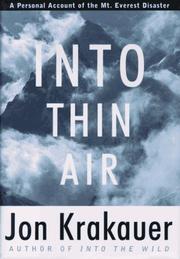
Into Thin Air - Jon Krakauer

2 comments so far. What do you think?
I read Into Thin Air as I was literally heading into thin air on my trek to Everest Base Camp this November. I read it for the first time 10 years ago and it helped foster an interest in mountaineering, culminating in this current trip.

It tells the true story of the ill-fated 1996 Everest climbing season, in which 15 people died while attempting to climb the highest mountain on Earth. Two of these climbers were experienced trekking leaders. Krakauer was a member of one of the expedition teams and was able to give a first hand account of the other climbers, the events as he saw them and his own responsibility in the ensuing tragedy.

Krakauer, a freelance journalist writes in an easy-to-read style. He knows how to draw the reader in and due to the personalised touch in his narrative, I felt an emotional connection to some of the characters.

The book focuses heavily on the question of what went wrong and whether it was linked to the commercialisation of Everest. It raises questions such as why didn't they turn climber's around at the pre-determined time? It really makes you think about the whole mountaineering experience from a different, more political angle.

I found it particularly fascinating to read this book on my way to Base Camp as I could visualise the events that occurred. It also provided me with valuable lessons on mountain climbing and the dangers of descending. As we climbed we visited the memorials of some of those who had died on Everest and it made this experience all the more sobering.

I know Krakauer was criticised after the release of the book for his portrayal of some of the other climbers and the blame he inadvertantly placed on the trekking companies. It is for this reason, that I'm hoping to read more accounts of this tragedy including Beck Weather's Left for Dead and The Climb : tragic ambitions on Everest by Anatoli Boukreev.

All up, however, this is probably one of my favourite books filled with emotional details and deep analysis of what can go wrong when commercialisation and the natural elements meet.


Share/Save/Bookmark

The Music Room by William Fiennes

0 comments so far. What do you think?
Another short and sweet biography just right for holiday reading. The author belongs to the well-known old English family Fiennes and remembers his childhood in the family seat, a moated "castle". The book was recommended to me by a local author for its beautiful use of language. A good example of this is the picture conjured up by "a long sibilance like water on shingle as thousands of barley whiskers brushed the body and wings....", when the glider touches down in the field.

It is essentially the author's recollection of his epileptic older brother Richard, his towering rages and subsequent moments of remorse, his superhuman strength, and love of Leeds United. There is a mellowness about the whole thing, the gentle patience of his parents, the secret doors and passages of the castle, and above all its lyricism, the leit -motifs of birds and water, and the way the word-smith weaves his magic. Interspersed throughout are scientific sections and snippets dealing with the early research into the brain and its electrical impulses, the first EEGs. The rest has a dream-like quality.

Next on my list by the same author is The Snow Geese, which promises to have the same charm.

Janet - Sylvania Library


Share/Save/Bookmark

Monday, 25 October 2010

Other People's Country - Maureen Helen

0 comments so far. What do you think?
"Rusty earth stretches into treeless distance...."

This is quality writing with a down-to-earth edge. In her late 50s Maureen Helen decided to become a remote area nurse. In this her first book (she later gained a doctorate in Writing) she gives an intelligent and disturbing account of conditions endured by community nurses in Jigalong WA, among the Martu people. Conditions are made difficult by the dry heat, lack of supplies and isolation, and the feeling of being not quite accepted. It is a detailed insight into the tribal mind; into "sorry business"; into "God's time" (where appointments are missed or forgotten) as opposed to our Western time constricted by timetables. She learns to handle cross-cultural situations with great delicacy. The story is packed with rich humanity, surprises and vivid description, and makes compelling reading.

Janet Samerski - Sylvania Library


Share/Save/Bookmark

Friday, 15 October 2010

Shimmer by Basia Bonkowski

0 comments so far. What do you think?
This biography I just could not put down. The author is a Sydney-based writer working in television. Her day by day account of her mother's decline (after a stroke and pneumonia) is told in simple, thoughtful, elegant prose in the present tense, with journeys into her Polish past, and of course, the path we all take when parents die. Other issues she touches upon are Aboriginal dispossession and Aboriginal culture versus European culture. The harrowing emotions experienced during her mother's final two weeks are beautifully expressed - "no one exists outside our fracturing family bubble", as the three siblings make the journey. It is a eulogy for her mother, "Shimmer" represents the chandeliers her mother loved so much. A wise book by a master wordsmith . . . A most satisfying read. Her previous book is also based on personal experience - "Jesse's world: a story of adoption and the global family".

- Sylvania Library


Share/Save/Bookmark

Monday, 11 October 2010

The Killing of Caroline Byrne by Robert Wainwright

0 comments so far. What do you think?
Robert Wainwright is a journalist with a career spanning twenty-five years. His career has ranged from politics to crime, but always focusing on the people behind the news.

Caroline Byrne was a beautiful 24-year old model pushed to her death off The Gap by her boyfriend Gordon Wood. This is the story of a grieving father determined to find the truth behind her death. The trial which put Gordon Wood behind bars did not commence until thirteen years after Caroline's death.

In 1986, Gordon Wood graduated from Sydney University with a degree in Economics. However, he did not use this degree, preferring to be an assistant to well known stockbroker/businessman Rene Rivkin. This involved driving Rivkin to his daily lunches and associating with the other assistants. Understandibly, Caroline was not happy with this arrangement. There were arguments because of his dominance and "gym junkie" lifestyle.

On a bleak winter's night in 1995, Caroline's body was found. When Gordon arrived on the scene he showed no emotion, led the Police to where he believed her body lay! How did he know? When her body was retrieved, he went through her wallet and stripped her bank account bare. According to friends he told them Caroline had been hit by a car.

After the inquest Gordon departed Australia and lived the high life in London and Europe . . . . . but he did not know of Mr Byrne's determination.

Wendy - Sylvania Library


Share/Save/Bookmark

Friday, 8 October 2010

Wordcrime : solving crime through forensic linguistics

0 comments so far. What do you think?
Tell kids not to worry. sorting my life out. be in touch to get some things. A family receives this text message from their mother's mobile phone. Do the words belong to her, or is it a cruel deception, a sign of something more sinister? Was The Da Vinci Code plagiarised? Can you fake a suicide note? Welcome to the world of forensic linguistics.
Wordcrime, by John Olsson, is about the application of linguistics to crime solving, so anyone who is fascinated with the English language will probably enjoy this book. While the writing is at times a bit dry, this appears to be from a need for the author, a practicing forensic linguist, to simply state the facts of each case. So you won’t find any of the luridness typical of some true crime books.
Each of the book’s 23 chapters covers a different case that the author was involved with, so it can be dipped in and out of. My favourite chapter was "Is the Da Vinci Code Plagiarism?" Although Olsson wants the reader to decide for his/her self on whether Dan Brown plagiarised the work of an earlier novelist, it is pretty clear where he thinks the evidence points on this question, and his analysis behind how writers choose certain words to describe a scene is fascinating.
Equally fascinating, and very poignant, is the author’s analysis of a suicide note for authenticity in "Murder or Suicide?” Olssen draws on the research of suicidologist Edwin Schneidman, combined with analysis of suicide notes from the British Transport Police, to illustrate how popular misconceptions of suicide can be detected in fake suicide notes. It is interesting also how computer databases of words, such as the Oxford and Cobuild corpus, even Google, are now indispensable tools in much linguistic analysis.
At the very least, the reader will come away from this book with the knowledge that the words we use and the way we arrange them can be like fingerprints when it comes to establishing authorship. Even when we are trying to pretend to sound like someone else, our words can in the end betray us.


Share/Save/Bookmark

Thursday, 23 September 2010

Happy Kids by Cathy Glass

0 comments so far. What do you think?
The title "Happy Kids" lured me in under false pretences. I thought it was a book about making your kids emotionally resilient however the truth is it is another discipline book. Cathy Glass has fostered over fifty children many with emotional and behavioural problems so she has to have developed some great techniques. Her main thesis is the 3Rs - request, repeat, reaffirm. She gives examples of applying the technique at different stages from baby to teen. Her main sanction idea is to limit tv/computer time. This would be a big threat in our house.

Glass also give good reasons for not using "the naughty chair" and "star charts". Two techniques I will gladly live without.


Share/Save/Bookmark

Monday, 20 September 2010

Yuendumu Everyday : Contemporary Life in remote Aboriginal Australia - Yasmine Musharbash

0 comments so far. What do you think?
Another anthropology student spends some time living in an Aboriginal community and turns her thesis into a book.
Yasmine records sleeping groups, and individual places within those groups to show how complex relationships in a community are made and nurtured without much need for verbal communication.
Yuendumu is on the Tanami Road, closer to Alice Springs than it is to Halls Creek.
Yasmine lives with the Walpiri people, describing their camps within the settlement and the fluidity of movement between these separate camps. Even the direction and placement of people's swags is documented and forms an important base for Yasmine’s work.
This was not a difficult read and the pages kept turning. I feel I have a little understanding of how much there is to take into account when trying to get suitable Aboriginal housing into these settlements, especially if the funding comes from outside and has to be spent within time frames that suit political purposes rather than taking the time to conceive of and develop structures that will suit fluid family structures and individual's obligations to family and community.


Share/Save/Bookmark

Monday, 13 September 2010

A New Earth : Awakening to your Life's Purpose

0 comments so far. What do you think?
Working from the basic principle that there is only ONE moment - this moment, NOW, - Eckhart Tolle constructs a modern spiritual guide to awakening into it, or "consciousness".

Imagine you have a clear insight to bringing "presence" into what you do and how you live.

Imagine you have found true peace from the practice of complete surrender to whatever is going on around you.

Imagine you know the secrets to being at ease with life and can remain in a state of non-resistance, non-judgment and non-attachment.

Imagine you have the insights into real happiness such as acceptance, enjoyment and enthusiasm.

In the NOW, everything is connected and perfect and whole and Tolle predicts that when the human race awakens to it, we will enjoy heaven on "A NEW EARTH"!

- Bronwyn Bailey 


Share/Save/Bookmark

Friday, 3 September 2010

A Dog's Life

0 comments so far. What do you think?
If you love canines and enjoyed watching the cantankerous Doc Martin and the motley villagers of of Port Wenn in the TV series, why don't you curl up with A Dog's Life by Martin Clunes?

The book arrived at our branch in a box of new titles and I was captivated by the four charming faces on the cover. It doesn't pretend to be a literary masterpiece: rather, a cosy account of the actor's love of dogs, his often exasperating experiences with three of his own, with some excursions into the science of canine behaviour. He visits a very unusual wolf sanctuary, African hunting dogs on the plains, and Fraser Island and the Central Desert in Australia to study the social structure of dingoes. He also studies the various breeds we have engineered, and their uses and problems. He includes police dogs, rescue dogs, hunters and ratters among others. The book is highly engaging with wonderful photos.Who would have thought that the irascible dog-hating doctor (poor Gremlin!) had such a soft spot in real life? The story has old-world West Country appeal, with touches of humour and sadness, and the scientific facts are well researched.

How many stars do you think it's worth?

Janet


Share/Save/Bookmark